If you run a marketing agency, your clients eventually expect to see their own data inside your reporting — attribution, channel performance, dashboards, the full analytics surface, presented as part of your service rather than a tool you bolted on. The question most agency owners reach quickly is: do we build that ourselves, license a commercial BI tool per seat, or stand up a platform we can embed and put our own brand on?
This guide focuses on the third path: white-label embedded marketing intelligence that lets you give clients a branded analytics experience without paying per-seat for every person who opens a chart. We’ll cover what “embedded” and “white-label” actually mean in practice, the capabilities that matter for a customer-facing platform, and how MIDAS delivers them.
What “embedded analytics” actually means
Embedded analytics is the practice of putting dashboards, reports, and self-service exploration inside the experience your client already uses — your portal, your reports, your domain — instead of sending them off to log in to a separate tool. In practice there are three integration patterns:
- Embedded dashboards. A client-facing dashboard rendered inside your portal or report, with access handled by a secure, scoped token. Fast to ship, and for most agency reporting it’s enough.
- Component embedding. Individual charts or query views dropped into your own layout, so the analytics blends with native UI and your branding end to end.
- The intelligence layer underneath. Beyond charts, the system that actually does the work — unifying channel data, running attribution, detecting anomalies, drafting recommendations — feeding whatever surface the client sees.
Most agencies start with embedded dashboards for speed. What sets a real platform apart is that the intelligence underneath is doing the hard analytical work, not just drawing prettier charts on the same shallow data.
What “white-label” buys you
White-labeling is the difference between “powered by some vendor” and “this is just part of what our agency delivers.” Concretely, it means:
- Your branding throughout — colours, fonts, logo applied to every surface a client sees, matching your agency’s identity.
- No third-party branding — no vendor logos, no “upgrade” buttons, no sign-up prompts leaking into the client’s view.
- Your domain — analytics served from your own subdomain, so the experience and the trust signals stay coherent.
- Invisible plumbing — the client never knows, and never needs to know, which engine renders their dashboard or runs their attribution model.
This is where building on an open, controllable stack matters. Because MIDAS runs on open-source infrastructure you fully control, the branding goes as deep as you need — not as deep as a vendor’s settings page happens to allow. Commercial BI tools routinely lock the white-label features that matter most — custom domains, removing branding, full theming — behind their most expensive tiers.
Multi-tenancy and security: the non-negotiables
The moment you’re serving analytics to clients rather than your own internal team, multi-tenancy stops being optional. Each client must see only their own data, with no possibility of leakage. The requirements:
- Row-level security. Every client sees only their own data, enforced at query time — regardless of which dashboard or report they open. MIDAS uses PostgreSQL row-level security so isolation is enforced at the database, not patched on at the surface.
- Scoped, revocable access. Client access granted through short-lived, single-tenant tokens — never a shared key that quietly exposes everyone.
- Workspace isolation. One client’s datasets, saved views, and permissions can never bleed into another’s.
- Audit trails. A clear record of who saw what, and when — the kind of thing enterprise clients and procurement teams expect before they sign.
Getting this right is exactly where a build-it-yourself approach tends to come apart. Multi-tenant isolation is unforgiving: it has to be correct every time, for every client, on every query.
Build vs. buy vs. white-label: the real trade-off
The pitch for commercial embedded analytics is that someone else runs the infrastructure and the SDK is polished. The cost is real, and it’s structural:
- Per-viewer licensing. You pay for every client user who opens a dashboard. For an agency with dozens of clients and many stakeholders each, that scales against you fast — it can turn a healthy retainer into a thin one.
- Shallow customization. When you need a view the tool doesn’t ship, you file a feature request and wait.
- Lock-in. Your dashboards and logic live inside a vendor’s format. Outgrow them and you start over.
Building entirely from scratch flips a different set of costs onto you: you now own data pipelines, attribution logic, a dashboarding layer, multi-tenant security, and the ongoing operations of all of it. That’s a data-engineering team’s full-time job — before you’ve served a single client.
White-label sits between these. You get a platform that’s already solved the hard parts — unification, attribution, multi-tenancy, branded dashboards — delivered as a service, with your brand on the front and predictable economics underneath. No per-viewer meter, and no data-science team to hire.
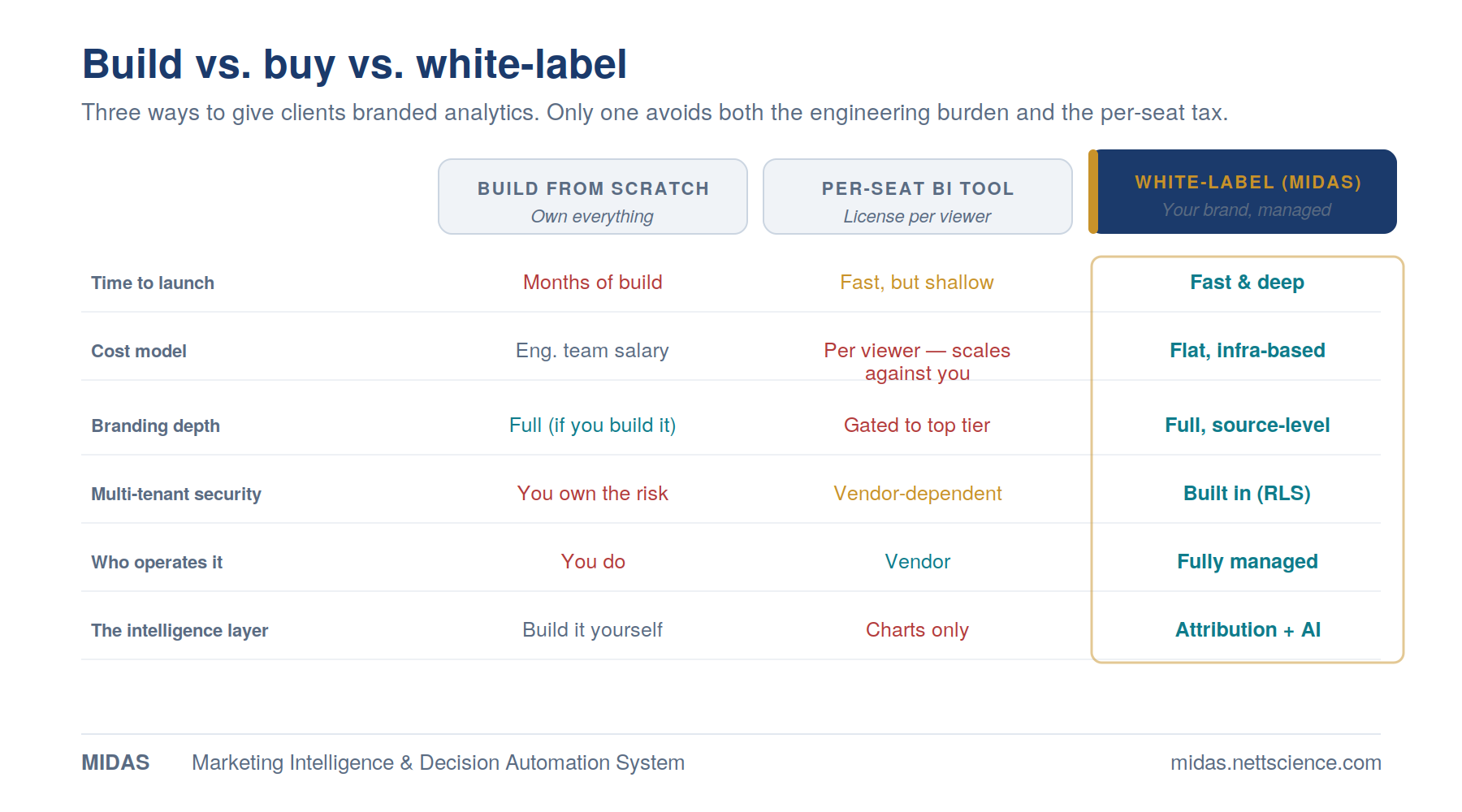
Building from scratch means owning the engineering; per-seat tools tax every viewer. White-label gives you branded, managed intelligence without either.
What’s under the hood of MIDAS
MIDAS is built entirely on open-source infrastructure, which is what makes deep white-labeling and clean multi-tenancy possible in the first place:
- n8n orchestrates every data pull, AI task, approval step, and channel action across all three layers.
- PostgreSQL is the system of record, with
pgvectorfor semantic AI memory and row-level security for client isolation. - dbt and Python run the transformations, attribution models, and feature engineering.
- Ollama runs open-source models locally for high-frequency, privacy-sensitive tasks, so client data isn’t routed externally for routine work.
- Apache Superset powers the client-facing dashboards — the same engine Airbnb, Lyft, and others run in production.
- Caddy is the secure gateway: it auto-provisions TLS and fronts the whole system, so everything else stays private behind it.
You don’t operate any of it. MIDAS is delivered as a fully managed service — we run the infrastructure, the security, and the upgrades; you put your brand on the front and deliver intelligence to your clients.
Why this works for agencies specifically
The agency model has a structural advantage hiding in it. You’re already doing the hard analytical work — pulling data from six platforms, reconciling numbers, building the client report. That work is the most valuable thing you produce, and most agencies give it away inside an execution retainer.
A white-label intelligence platform lets you productize it. The same de-duplicated attribution, anomaly detection, and recommendation engine, delivered under your brand, becomes a defensible, recurring line item — not an afterthought. And because the economics scale with infrastructure rather than per viewer, adding clients and stakeholders doesn’t quietly erode your margin.
The bottom line
For customer-facing marketing analytics — the white-label, multi-tenant, client-sees-their-own-data case — building from scratch is rarely worth it, and per-seat commercial tools quietly tax your growth. The most complete answer is a managed, open-source-based platform that hands you the branding and hides the plumbing.
That’s what MIDAS is built to be: enterprise-grade marketing intelligence, delivered under your agency’s brand, without the data team or the per-viewer bill.
MIDAS is a fully managed, white-label marketing intelligence platform built by NettScience on an open-source stack — n8n, Ollama, PostgreSQL, Superset, dbt, Python, and Caddy. If you run an agency and want to offer client analytics under your own brand, book a call or contact us at analytics@nettscience.com.