There’s enormous excitement right now about handing marketing decisions to AI. Ask a question in plain English, get the right number. Let the system reallocate budget on its own. Watch dashboards write themselves. The promise is autonomy: marketing that runs itself.
In controlled demos, this already works most of the time. But “most of the time” is the problem. In real marketing decisions — where budget is reallocated, where a CMO reports numbers upward, where trust is on the line — 90% right simply doesn’t cut it.
The most useful analogy is self-driving cars. We’re not at full autonomy. What we have today is more like lane assist: the system helps, suggests, and automates parts of the drive, but a human stays ready to take over. That’s exactly the right model for AI in marketing analytics — and it’s the principle MIDAS is built on.
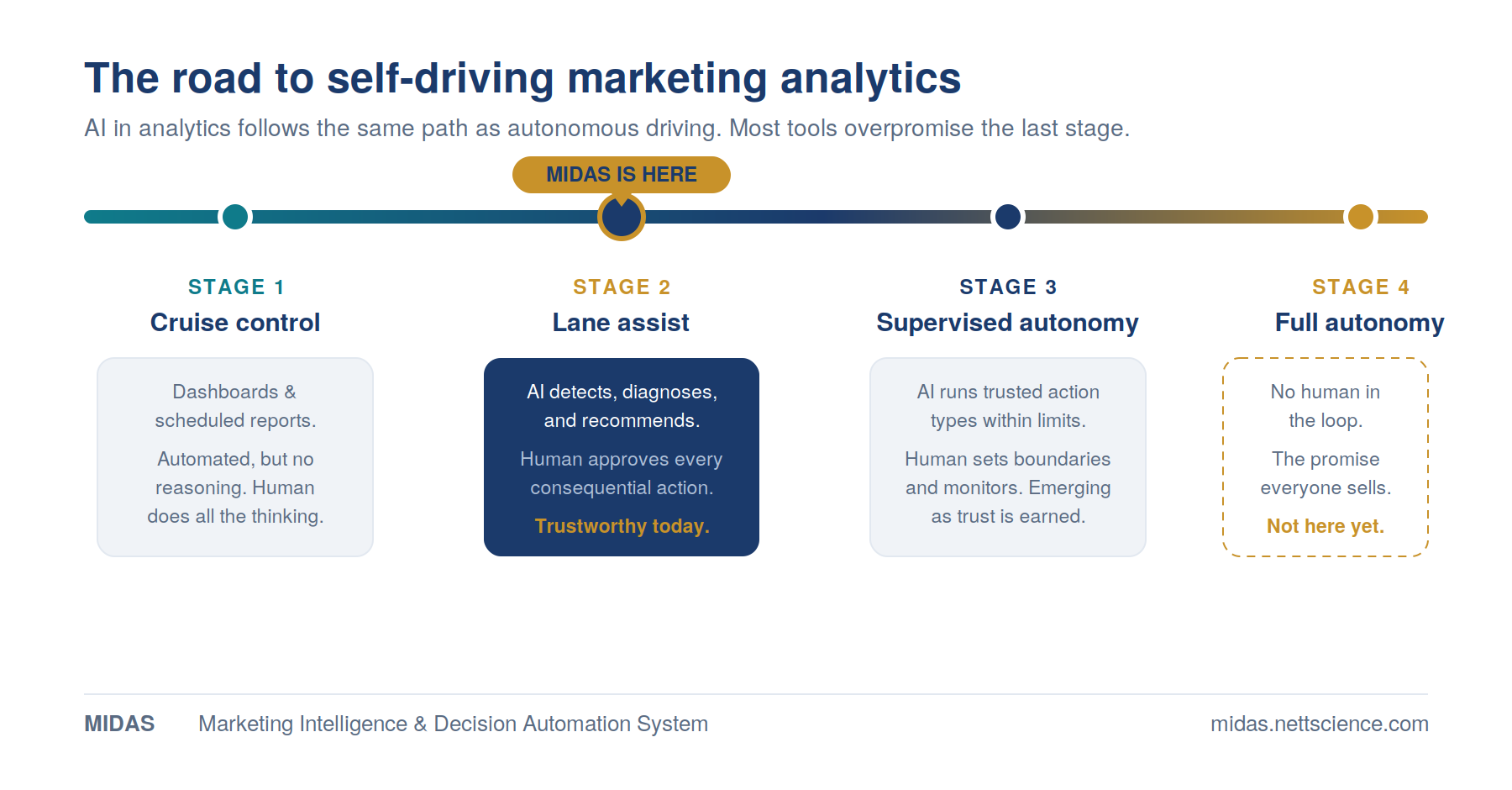
AI in marketing analytics follows the same path as autonomous driving. Most tools overpromise full autonomy; MIDAS operates trustworthily at lane assist today.
Two kinds of marketing AI tasks
Not every task carries the same risk. It helps to split them.
1. Tasks where accuracy is critical. Anything that drives a decision or gets reported needs to be right, not roughly right:
- Cross-channel attribution and de-duplicated conversions
- Budget reallocation recommendations
- Channel ROI, CAC, and lifetime-value figures
- Anomaly alerts that trigger spend changes
If the AI is even slightly wrong here, trust collapses fast — and once it’s gone, people stop using the system and go back to their spreadsheets. These tasks demand a human in the loop: someone who knows the data and the business and can validate what the AI proposed before it ships.
2. Tasks where suggestions are enough. A large category of work just needs to be helpful, not perfect:
- Drafting a plain-English summary of a dashboard
- Suggesting which charts best show a new metric
- Surfacing patterns or outliers worth a closer look
- Proposing the next question to ask
Here, a “mostly right” answer is genuinely useful. The cost of a miss is low, the feedback loop is fast, and users build trust easily because they’re not auditing the output — they’re using it as a shortcut.
The mistake most “AI marketing” tools make is treating every task like category two, when the decisions that matter live in category one.
Why validation has to happen in context
If AI is going to be supervised, the human has to be able to supervise it where they already work — not in a separate chat box that hides the details. A black-box “trust me” answer is the fastest way to lose a marketer’s confidence.
In MIDAS, that means an AI recommendation never arrives as a bare instruction. It arrives with its reasoning exposed:
- The situation it detected (e.g. CPA running above target in a segment)
- The diagnosis — what the data suggests is driving it
- The proposed action, and the expected outcome
- The underlying data, so the human can trace and verify it
The marketer can approve, modify, defer, or reject — right there, without leaving the interface. It’s assisted driving: if you need to take the wheel, the controls are under your hands, not in another system.
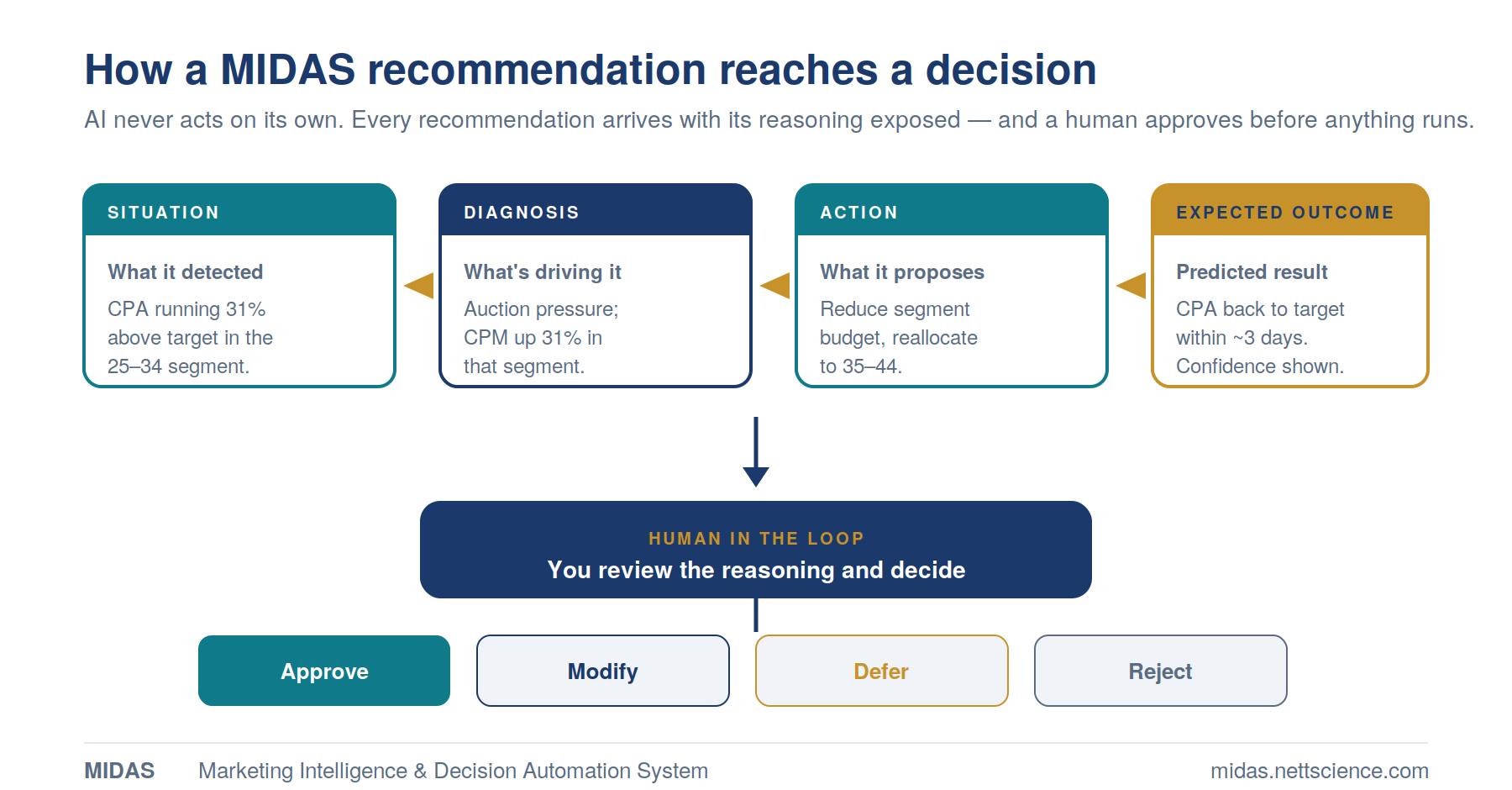
Every MIDAS recommendation arrives with its reasoning exposed — and a human approves before anything runs.
What full self-driving analytics would actually require
It’s tempting to imagine AI running the entire marketing analytics loop end to end, no human involved. But just like with cars, getting there takes far more than a better model. A few things have to be solved first:
- Rich context and metadata. A model can’t reason well about your marketing data without knowing the definitions behind it — what “qualified lead” means, how channels are grouped, which data is trusted. That context is usually scattered across tools, docs, and people’s heads.
- Seamless human–AI handoff. Taking over has to be instant and lossless. If stepping in means starting from scratch, no one will trust the system.
- Stronger feedback loops. AI improves on feedback — explicit (approve / reject / edit) and behavioural (did the recommendation get acted on, reversed, or ignored?). MIDAS treats every approval decision as a signal that sharpens the next recommendation.
- Confidence gating. Today’s models often answer confidently even when unsure. In marketing, that’s dangerous. Sometimes the right output is “I’m not certain — here’s why.” Knowing when not to act is a feature, not a flaw.
These are the building blocks on the road to autonomy. Not just a smarter model — better context, tighter feedback, and an interface built for human–AI collaboration.
The honest lessons from building this
A few things become clear quickly when you build AI into real analytics rather than a demo:
- Real marketing data is messy. In a clean benchmark, every field is labelled and every table makes sense. In a real account, channels are named inconsistently, some data is available but not trusted, and definitions drift. No amount of clever prompting overcomes ambiguous data — the AI needs help from metadata, from structure, and from humans.
- More context isn’t always better. Stuffing everything into the model can cause as many errors as too little — it mixes sources and picks the wrong fields. Precision in what you feed the model matters more than volume.
- Trust is fragile. When it works, it’s genuinely impressive. But a couple of wrong numbers and a user is gone. That asymmetry is why the human checkpoint isn’t a limitation — it’s what makes the whole system usable.
Designing for copilots, not autopilots
The real opportunity in AI for marketing today isn’t full automation. It’s collaboration. The best version of AI here is a copilot — something that moves you faster, gives you ideas, and saves you time, while keeping you in control.
Different users need different things from it:
- Analysts and agency teams want control. AI gives them a fast first draft and surfaces options they hadn’t considered.
- CMOs and stakeholders want speed and clarity. AI reduces friction without hiding the path — show the reasoning, let them trace it, give them confidence in what they’re seeing.
And the best copilots are transparent. They show their work — the data used, the assumptions made, the logic followed — so issues get caught before they become problems. That’s not replacing trust with automation; it’s earning trust through visibility.
The bottom line
We’re still early in AI for marketing analytics — somewhere between cruise control and lane assist. The potential is real and already delivering value. But the systems that win won’t be the ones racing to remove humans from the loop. They’ll be the ones that apply AI aggressively where it’s safe, keep a human in control where it counts, and show their work every step of the way.
That’s the principle behind MIDAS: intelligent automation, with a human in the loop. The future of marketing analytics isn’t hands-free. It’s collaborative.
MIDAS is a fully managed, human-in-the-loop marketing intelligence platform built by NettScience. If you’d like to see how AI-assisted, human-approved marketing decisions would work on your data, book a call or contact us at analytics@nettscience.com.