Most marketing teams read the articles about first-party data, nodded, added it to a quarterly planning document — and carried on building their measurement approach on Google, Meta, and LinkedIn’s self-reported numbers. The case for doing the work differently has never been stronger. Not because of regulatory pressure. Because the data is genuinely better.
What First-Party Data Is — and Why It Outperforms Third-Party Data
First-party data is data you collect directly from your customers and prospects — with consent, through your own channels. Surveys, website behaviour, purchase history, email responses, sales conversations, satisfaction scores.
Third-party data is collected by someone else and made available to you through platform targeting or data brokers. The gap between the two is widening for three compounding reasons.
Third-party data is degrading. Cookie deprecation, iOS privacy changes, and browser-level tracking restrictions have been eroding targeting signal quality for five years. This is structural — it will not reverse.
Third-party data is shared. Your competitors buy the same audience segments, target the same intent signals, and bid against the same pools. There is no competitive advantage in data everyone can purchase.
Third-party data stops at the platform boundary. Google’s conversion data covers what Google can see. Meta’s covers Meta’s ecosystem. Neither sees your customers’ full relationship with your brand — the post-purchase satisfaction, the repeat behaviour, the referral. Platform data is always a partial view.
First-party data, by contrast, is not subject to API changes or cookie deprecation. It captures the full customer relationship. It gets richer with every interaction. And it cannot be replicated by a competitor regardless of budget.
The Four Sources Most Businesses Are Not Using
Most businesses collect some first-party data. Almost none connect what they collect to their marketing intelligence systems. These four sources consistently deliver the highest return relative to effort.
1. Post-Purchase Surveys
A single question immediately after purchase — “How did you first hear about us?” — produces what no attribution model can: self-reported data on top-of-funnel channels.
Multi-touch attribution tracks digital touchpoints reasonably well. It is structurally blind to the channels that actually introduce people to brands — podcasts, word-of-mouth, organic social discovery. When post-purchase survey responses are reconciled against modelled attribution, these channels frequently appear in 20–40% of responses as the first point of discovery, while receiving near-zero model credit.
A single-question Typeform or Qualtrics survey triggered post-purchase achieves 30–50% response rates — enough to produce statistically meaningful data within weeks.
2. Customer Satisfaction and NPS Data
NPS and CSAT are the leading indicators of retention and lifetime value that marketing spend data will never surface. Connected to your CRM and acquisition data, they answer the question most teams cannot: which channels produce the best customers — not the most conversions?
This distinction matters. Channels that appear expensive on cost-per-acquisition frequently look different when filtered by the NPS and retention rate of the customers they produce. Without satisfaction data in your marketing model, you are optimising for the wrong metric.
3. Preference and Interest Data
Behavioural data tells you what someone did. Stated preference data — collected at signup or through progressive profiling — tells you what they want. The combination produces segmentation quality that behavioural signals alone cannot match, particularly for early-stage prospects who have not yet exhibited revealing behaviour.
Progressive profiling — one question at signup, one at each subsequent meaningful interaction — builds rich profiles without friction. After six months, the resulting data asset is a genuine competitive differentiator: a view of your customer base that no platform can observe and no competitor can buy.
4. Sales Team Intelligence
The most overlooked source — and often the highest quality one.
Your sales team knows which objections prospects raise, which competitors they are evaluating, and what the actual buying criteria are. This intelligence lives in sales team memory, evaporates when people leave, and almost never connects to the marketing system.
The fix requires no sophisticated technology. A mandatory CRM field — pre-coded objection categories, a competitor dropdown, a free-text notes field — populated after every qualified call. What you gain is a direct feed from market reality to your marketing data: which channels produce the prospects your team closes most effectively, and which competitors appear most frequently in deals that stall.
How MIDAS Creates a Unified First-Party Intelligence System
The challenge with first-party data has never been quality. It has been integration. Survey data sits in Typeform. NPS responses sit in Delighted. Preference data sits in the email platform. Sales intelligence sits in a CRM field nobody queries. None of it connects to the attribution models or audience intelligence driving campaign decisions.
MIDAS solves this through its unified PostgreSQL data warehouse — a single data model that treats first-party sources as first-class inputs alongside paid media, organic, CRM, and email data.
For each first-party source, MIDAS creates a standardised intake table. Survey data arrives via n8n webhooks in real time. Sales team intelligence flows through the existing CRM integration. The result: first-party data sits in the same warehouse as your Google Ads spend, your attribution models, and your lead scores — queryable together, available to the AI recommendation system as context for every decision it surfaces.
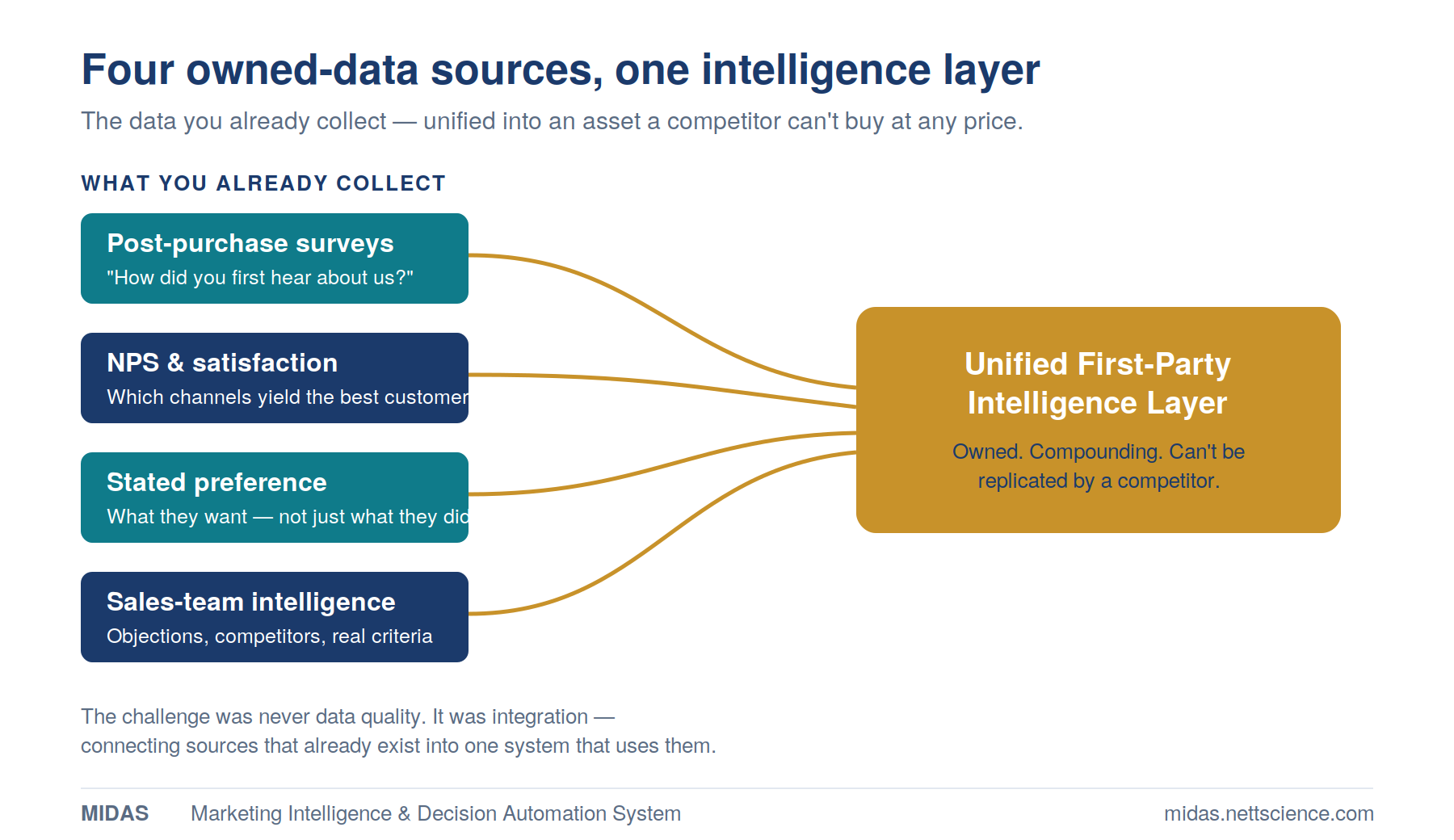 The challenge was never data quality. It was integration.
Four capabilities this directly enables:
- Post-purchase attribution reconciliation — weekly comparison of model attribution against survey-reported discovery, surfacing the channels your model systematically under-credits
- NPS-segmented channel analysis — acquisition channel performance broken down by eventual customer satisfaction and retention, not just conversion rate
- Sales intelligence in AI recommendations — objection and competitor data from the CRM informs AI-generated recommendations, so the system accounts for close-rate quality downstream of acquisition
- Preference-based segmentation — stated preference data enriches lead scoring and audience models, producing targeting based on intent rather than past behaviour alone
The Competitive Scarcity Argument
There is a longer argument that goes beyond current analytical value. As third-party tracking continues to degrade, the businesses that have built systematic first-party collection will have a data asset that competitors who relied on platforms do not. The preference profiles, the survey-based attribution, the sales intelligence — none of this is available through any platform at any price.
The technology to collect and use this data is available now. The decision is an organisational one: asking the question after purchase, building the preference field into the signup flow, making the CRM field mandatory for the sales team. The infrastructure is ready. The question is whether the commitment is.
MIDAS is a marketing intelligence platform built by NettScience. To see how first-party data sources would be integrated into a unified intelligence model for your business, book a demonstration or contact us at analytics@nettscience.com.