Two findings from the 2026 CMO Survey, published within a page of each other, tell the whole story of marketing right now.
The first is a triumph. AI use in marketing has nearly doubled in two years — from 13.1% of marketing activities in 2024 to 24.2% in 2026. Generative AI grew 220% over the same period. Marketers project AI will account for more than half of all marketing activity within three years.
The second is a quiet disaster. No marketing technology activity scores above 5 on a 7-point performance scale — and performance levels have not improved in two years. “Generating ROI from marketing technologies” sits at 4.5. “Demonstrating ROI” scores 4.0.
Read those together. Adoption has surged. Performance has flatlined.
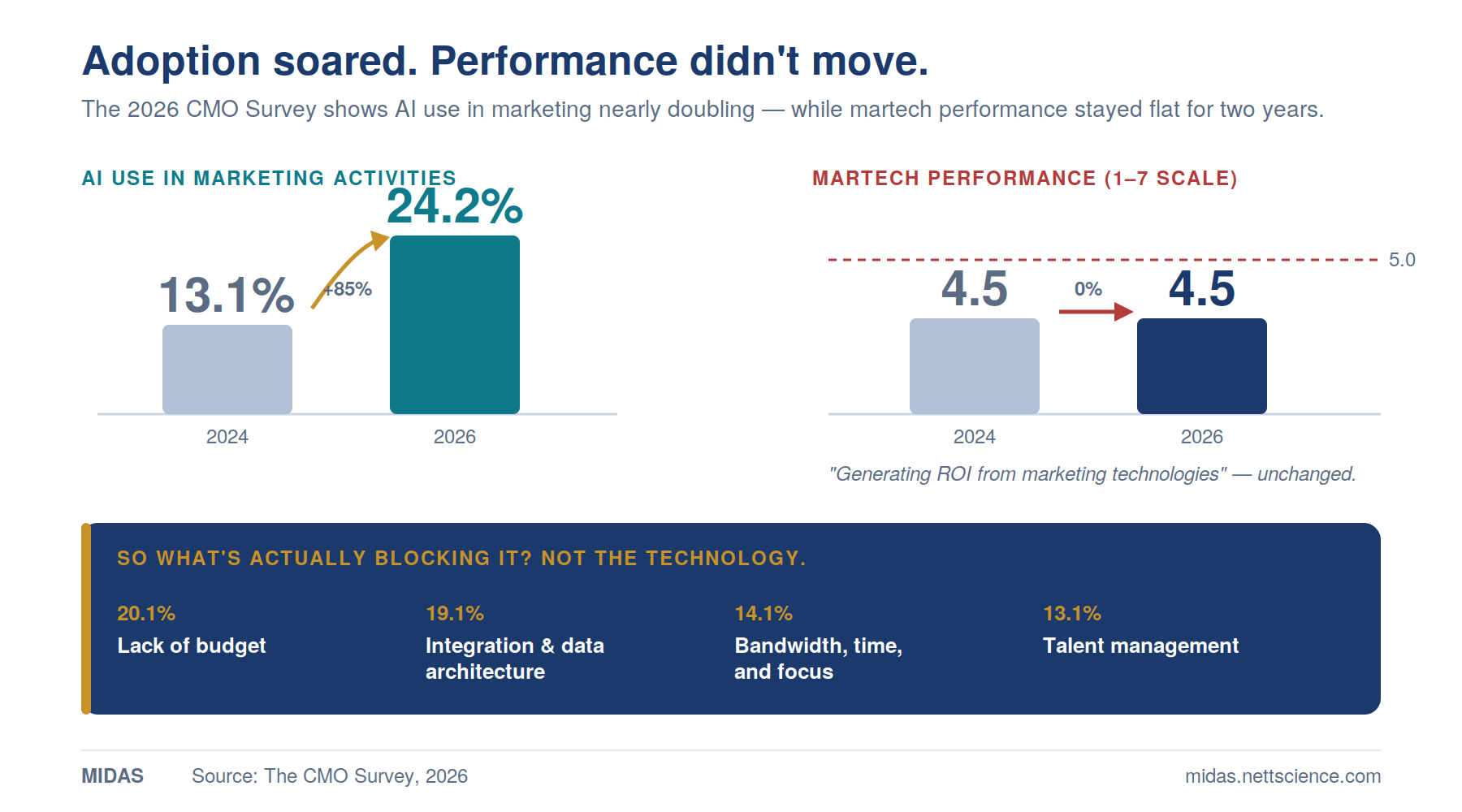
Source: The CMO Survey, 2026. Adoption nearly doubled. Performance didn’t move — and the barriers have nothing to do with the software.
So the question worth asking isn’t “should we adopt AI?” That decision has already been made, by nearly everyone. The question is why the enormous investment in marketing technology is producing such stubbornly mediocre returns — and whether buying another tool will change anything.
The barrier isn’t the technology
When The CMO Survey asked marketers to name the biggest obstacle to getting value from their marketing technology, the answers weren’t about the technology at all:
- Lack of budget — 20.1%
- Technology integration and data architecture — 19.1%
- Bandwidth, time, and focus — 14.1%
- Talent management — 13.1%
Not one of these is solved by better software. As the survey’s own authors put it, these barriers reflect a common underlying condition: investment in technology has outpaced investment in the organisational capabilities needed to use it effectively.
Gartner’s data says the same thing from a different angle. 57% of CMOs report they lack the talent to execute their marketing strategy. And when asked what most blocks AI-driven marketing efficiency, the top answer was a lack of internal talent — cited by 38% of CMOs in their top three.
Most striking of all, from Deloitte’s read of the same survey: marketers now cite “the right talent” over “the right technology” as the most important driver of revenue growth.
The industry has spent three years selling CMOs more technology. The CMOs are telling us, clearly and repeatedly, that technology was never the missing piece.
What actually happens after you buy the AI tool
The pattern is familiar to anyone who has lived it.
A mid-market team licenses an AI-powered analytics platform. It genuinely can do attribution, anomaly detection, and predictive scoring. The demo was impressive.
Then reality arrives. Someone has to connect it to eleven data sources with inconsistent naming. Someone has to define what “qualified lead” means so the model has something coherent to learn from. Someone has to interpret the outputs, sanity-check them against what they know about the business, and decide what to actually do. Someone has to notice when a platform changes its API and the data silently stops flowing.
That someone doesn’t exist. The marketing team is already stretched — bandwidth was the third-biggest barrier for a reason. The tool ends up running at maybe 20% of its capability, producing dashboards nobody fully trusts, and the CMO quietly stops citing it in board meetings.
The technology worked. The operating model didn’t.
This is why martech performance scores have not moved in two years despite AI adoption doubling. You cannot buy your way out of a capability gap.
The managed-service alternative
There is a different way to close the gap, and it starts by being honest about what’s actually missing.
If the constraint is bandwidth, talent, and integration — not software — then the answer isn’t another platform for your team to operate. It’s a platform plus the people who operate it.
That’s the model MIDAS is built on. It is a fully managed service, not a tool you log into:
- We run the infrastructure. The data pipelines, the integrations, the models, the monitoring. When a platform changes its API, that’s our problem, not yours.
- We run the analytics. Attribution modelling, anomaly detection, lead scoring, content and competitive intelligence — configured for your business, operating every day.
- You make the decisions. Recommendations arrive with their reasoning exposed: the situation, the diagnosis, the proposed action, the expected outcome. You approve, modify, defer, or reject.
You don’t need to hire a data scientist. You don’t need to integrate anything. You don’t need to develop internal capability before the investment pays off. The capability arrives fully operational — which is exactly what the survey data says most teams are missing.
Why this is the right shape for the problem
Look again at the four barriers, and notice how a managed service addresses each one:
- Bandwidth — the operational load sits with us, not with a marketing team that’s already at capacity.
- Talent — you get analytical expertise as a service rather than a hire you can’t find or afford.
- Integration — unifying fragmented channel data is the core of what the platform does, not a project you have to run first.
- Budget — no data-science salaries, no infrastructure, no year-long implementation before value appears.
Note that the CMO Survey found martech performance hasn’t improved in two years — meaning the market has been running this experiment at scale, and the “buy more technology” strategy has now had a fair trial. It didn’t work.
The ROI question, answered honestly
Here’s the harder truth underneath all of this. CMOs are under more pressure than ever to prove return — ROI measurement is now the single biggest challenge marketing leaders name — and much of the AI investment made in the last three years has quietly failed that test.
Not because the AI was bad. Because it was dropped into organisations that had no capacity to run it, no unified data for it to reason over, and no one whose job it was to turn its outputs into decisions.
The way out isn’t more ambitious technology. It’s a delivery model that assumes the CMO’s team is busy, that the data is messy, that nobody is available to become a machine-learning engineer — and works anyway.
That’s what “managed” means. Not a lighter version of the software. A different answer to the actual problem.
The bottom line
Adoption is not the same as capability. Nearly every marketing team now has AI. Almost none of them have the bandwidth, the talent, the integration, or the operating model to get real return from it — and the numbers have been flat for two years while the industry kept selling more tools.
If your marketing technology isn’t delivering what it promised, the honest diagnosis is probably not that you picked the wrong platform. It’s that nobody has the time to run the one you have.
Fix that, and the ROI follows.
MIDAS is a fully managed marketing intelligence platform built by NettScience. We run the infrastructure, the integrations, and the analytics — you make the decisions. If your marketing data isn’t earning its keep, book a call or contact us at analytics@nettscience.com.