A mid-sized business today runs campaigns across Google, Meta, LinkedIn, email, organic search, and social — all at once. Each platform reports in its own language. Each one claims credit for conversions the others also claim. And somewhere inside that fragmented picture sits the question that actually matters: which channels are genuinely driving revenue?
For most mid-market teams, that question goes unanswered. Not for lack of data — marketing generates more data than almost any other business function — but for lack of unified, reasoned intelligence that connects the data to a decision.
Why single-platform attribution misleads
When every ad platform measures its own contribution, you get a sum that adds up to more than 100%. Meta says it drove the sale. Google says it did. Your last-click model quietly hands all the credit to whichever touch happened to come last — usually branded search, which was going to convert anyway.
The result is a budget allocated on flattering, self-reported numbers rather than on what truly moved the customer. Spend flows to the channels best at claiming credit, not the ones best at earning it.
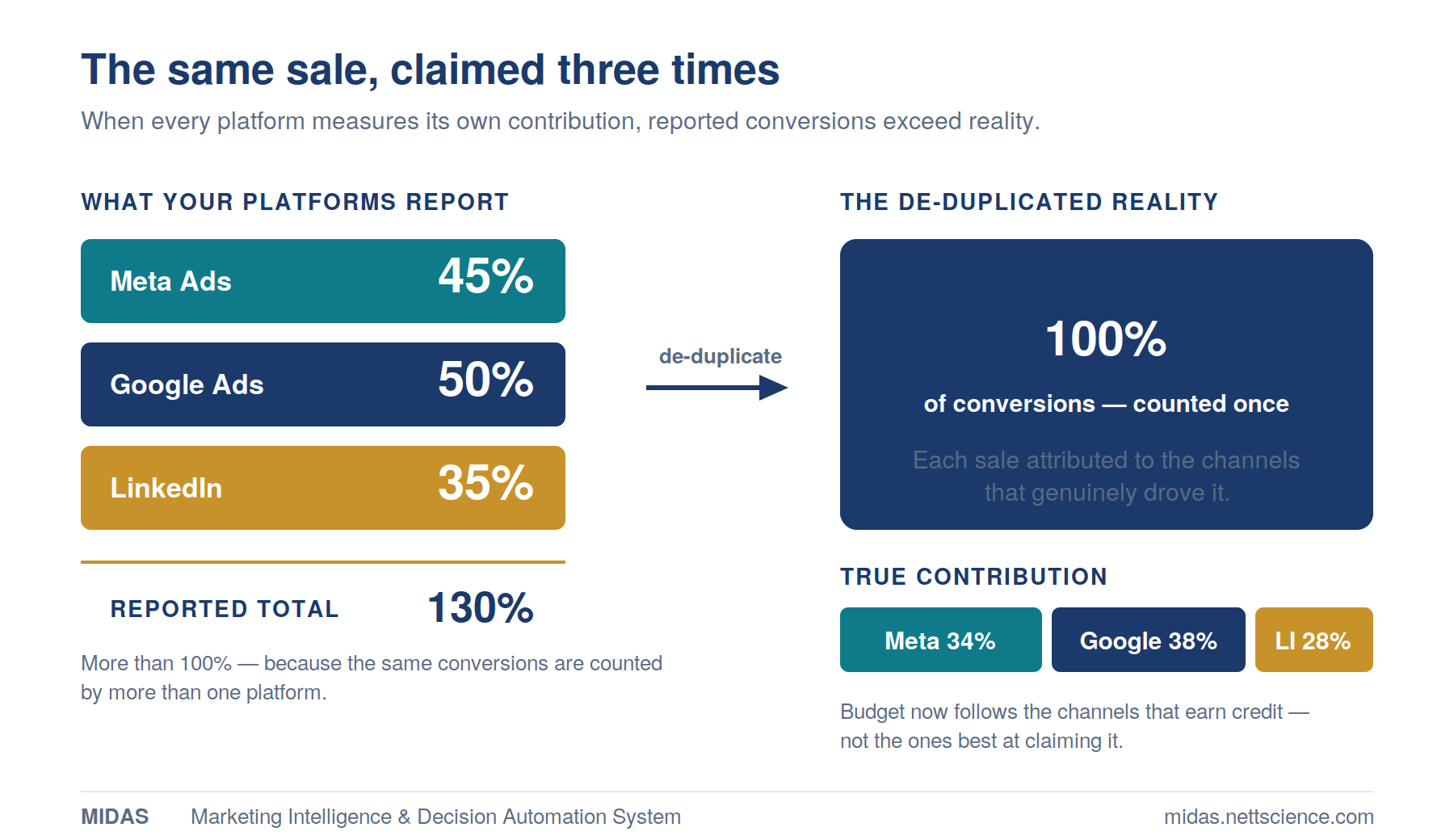
When every platform claims the same sale, reported conversions exceed reality.
What changes with a cross-channel view
The fix isn’t another dashboard. It’s a layer that sits above the platforms, ingests every channel’s data, and reasons across them as one system:
- Conversions are de-duplicated, so two platforms can’t both bank the same sale.
- Cross-channel paths become visible — the LinkedIn touch that started the journey gets its due, not just the search click that ended it.
- Recommendations are data-derived, not analyst opinion or platform spin.
The problem is not the absence of data. It’s the absence of intelligence that connects data to decisions.
The mid-market reality
Enterprise attribution platforms solve this — at six figures a year and six-to-eighteen-month implementations that need a dedicated internal team. That math doesn’t work below the enterprise tier.
This is exactly the gap MIDAS was built to close: enterprise-grade cross-channel intelligence delivered as a managed service, at mid-market price points, with client data staying fully in-house. Layer 1 — Data & Intelligence — does this work today.
If your reporting still answers “what happened on each platform” rather than “what actually drove revenue across all of them,” that’s the blind spot worth closing first.
Want to see your own channel data through a unified lens? Book a demo and we’ll walk you through it.