Walk into almost any mid-sized marketing agency and you’ll find the same quiet inefficiency. Somewhere in the building, someone is pulling data from six platforms into a spreadsheet, reconciling numbers that don’t agree, and turning it into a monthly client report. That work is hard, it’s skilled, and it’s the part clients quietly value most.
And the agency is giving it away — folded into an execution retainer, priced as if it were an afterthought.
After fifteen years building marketing analytics for agencies, starting with one of the largest in the world, I’ve come to believe this is the single biggest unsold product in the agency world. Not a new service to invent. One you’re already delivering, just not naming, packaging, or charging for.
The trap: selling hours when clients want certainty
The traditional agency model sells activity. Posts published, campaigns launched, creative produced, hours logged. It’s measurable, it’s familiar, and it’s a race to the bottom — because activity is a commodity. There’s always another agency willing to publish more posts for less.
What clients are actually anxious about is something activity can’t answer: is any of this working, and how do I know? They don’t lie awake worrying whether you posted on schedule. They lie awake wondering whether their budget is compounding or leaking.
That anxiety is the opening. The agency that can answer “here’s what’s working, here’s the evidence, here’s what we’re changing because of it” is selling something no commodity competitor can match: certainty. And certainty comes from intelligence, not activity.
Why intelligence is the most defensible thing you sell
Execution is replaceable. Anyone can run ads. Intelligence is sticky for a simple reason — it compounds. Every month you analyse a client’s cross-channel performance, you understand their business a little better than the last agency ever did. You learn which channels actually drive their revenue, not just which ones claim credit. You build a picture of their customer that would take a replacement six months to rebuild.
That accumulated understanding is a moat. A client can fire the agency that publishes their posts without much pain. Firing the agency that understands their numbers better than they do is far harder — and that’s exactly the position you want to be in when the renewal conversation comes around.
The irony is that most agencies already do this work. They’ve just buried it so deep inside the retainer that the client never sees it as a distinct, valuable thing. It shows up as a PDF attachment, not as the strategic asset it actually is.
What “selling intelligence” actually looks like
This isn’t about inventing a data-science division overnight. It’s about reframing and elevating what you already produce. A few concrete shifts:
Stop attaching the report and start presenting the decision. The monthly deliverable shouldn’t be a dashboard of numbers — it should be a short, reasoned recommendation: here’s what the data says, here’s what we’re going to do differently, here’s the expected impact. The numbers are the evidence; the decision is the product.
Make the intelligence a named line item. When analytics lives inside an undifferentiated retainer, it has no price and no perceived value. Break it out. Give it a name. Let the client see they’re paying for intelligence, because the moment they can see it, they can value it — and they’ll resist losing it.
Show the trajectory, not just the snapshot. A single month’s report is a photo. What clients pay a premium for is the curve — the evidence that your decisions are improving outcomes over time. “Here’s where we were at month one, here’s where we are at month twelve, here’s why” is a renewal-winning conversation that activity reporting can never have.
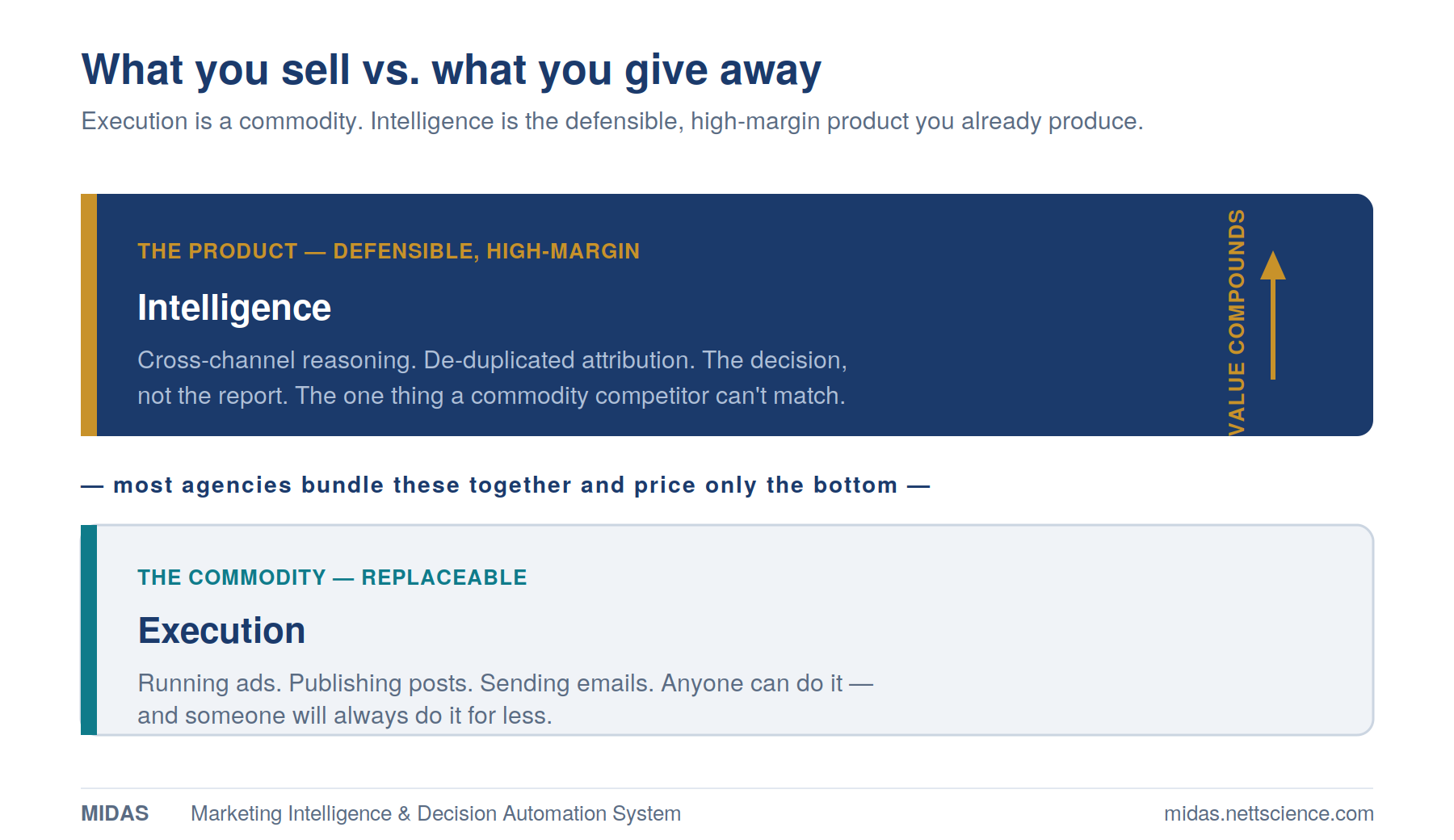 Execution is replaceable. Intelligence is the product you already produce — and give away.
The thing standing in the way
If this is so valuable, why don’t more agencies do it? Because the infrastructure is genuinely hard. Unifying data across every channel, de-duplicating conversions that three platforms all claim, reasoning across the whole picture rather than platform by platform — that’s exactly the work that enterprise analytics platforms charge six figures and six-month implementations to deliver. For a mid-market agency, building that in-house means hiring data scientists and standing up infrastructure that the margins don’t support.
So the capability stays locked behind cost, and the agency keeps giving away the diluted version it can manage by hand.
This is the gap we built MIDAS to close — to give agencies enterprise-grade cross-channel intelligence as a managed service, white-labelled, without the headcount or the infrastructure bill. But the strategic point stands whether you use us or not: the intelligence you’re already producing is your most valuable, most defensible, highest-margin product. The only mistake is continuing to give it away.
The agencies that will win the next decade aren’t the ones publishing the most. They’re the ones who can look a client in the eye and say, with evidence, exactly what’s working and why — and charge accordingly.
We help agencies deliver enterprise-grade marketing intelligence to their clients without building a data team. If that’s a conversation worth having, download the Agency Intelligence Playbook or book a demo.